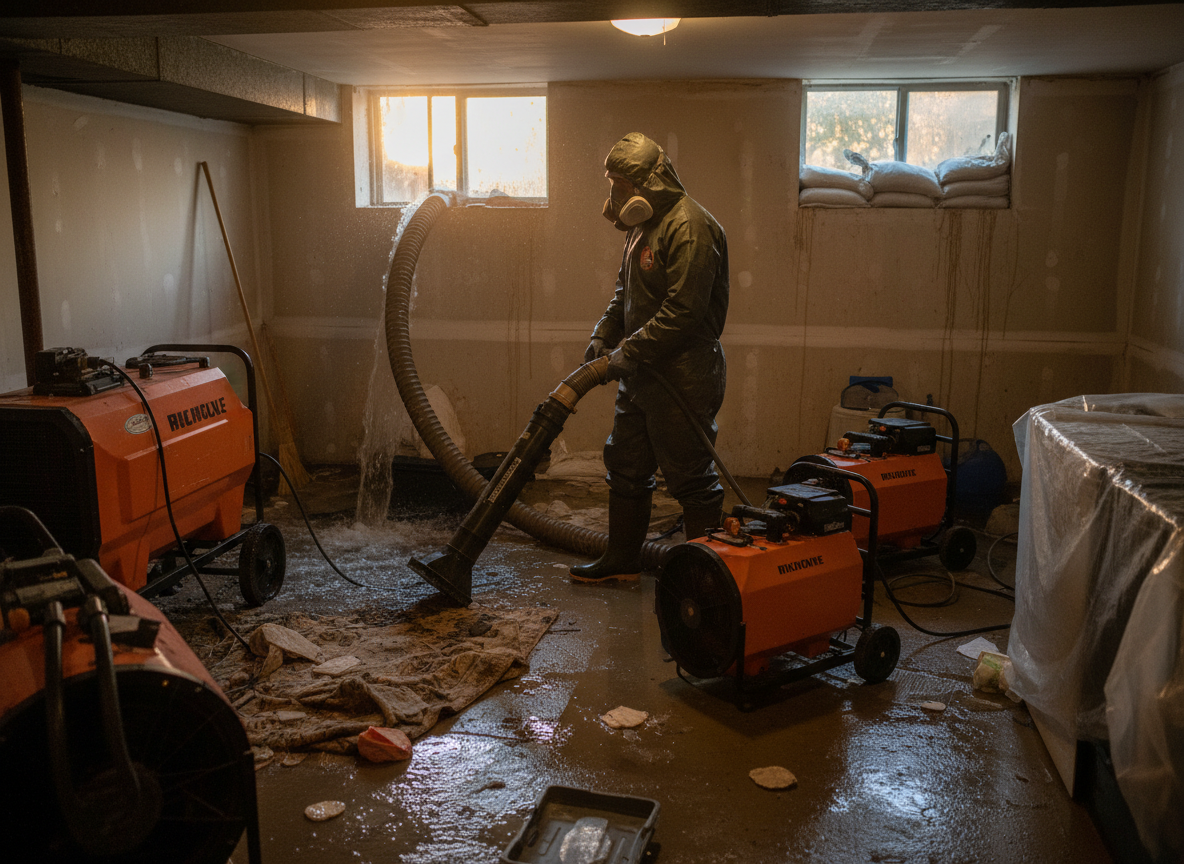
Yonkers sits in Westchester County where older brick and frame homes from the early 1900s through 1950s line streets near the Bronx River and Saw Mill River. Many of these properties have fieldstone or poured concrete basements that take on water during nor'easters and summer thunderstorms when drainage systems built for lighter loads get overwhelmed. Flood restoration here starts with mapping how water traveled through joist bays and behind plaster walls rather than just pulling up carpet.
After the water recedes, hidden moisture often remains in lath-and-plaster walls and under hardwood floors installed over concrete slabs. Technicians use moisture meters and thermal imaging to find pockets that standard fans miss, then remove saturated insulation and baseboards so the structure can dry without mold growth. In neighborhoods like Getty Square and Lincoln Park, narrow lots and shared driveways limit equipment placement, so portable dehumidifiers and air movers get staged inside while exterior pumps handle street-level runoff.
Westchester County building codes require permits for any structural drying that affects load-bearing elements, and insurance adjusters here expect detailed drying logs that document temperature and humidity readings every twenty-four hours. Skipping these steps can delay claims or force rework when a finished basement in a Tuckahoe Road home fails a final inspection.
Homeowners often discover that floodwater carries silt from the Hudson and Bronx River corridors, which settles into subfloors and HVAC returns. Removing this sediment before drying prevents ongoing odors and reduces the chance that fine particles will circulate through the house once systems restart.
Technician insight
In Yonkers, the thing that catches most people out with Flood restoration services is how quickly river silt from the Bronx River settles into the gravel under older basement slabs on streets like Tuckahoe Road. Homeowners assume once the water is pumped out the job is done, but that fine sediment stays wet for weeks and forces us to open more floor than they expect.
Basement Flood After Heavy Rain Near Lincoln Park
Water entered through a 1920s foundation wall during a July thunderstorm and rose eight inches across the finished basement. We found saturated carpet pad and insulation behind the drywall on the north wall. Extraction and targeted drying prevented mold in the joist bays; the homeowner was back in the space within ten days.
How it works
- 1
Initial Assessment
Technicians arrive within hours, document water depth and source, and test for contaminants common in Yonkers river and sewer backups.
- 2
Water Extraction
Submersible pumps and truck-mounted units remove standing water from basements and crawl spaces while protecting adjacent finished areas.
- 3
Drying and Monitoring
Industrial dehumidifiers and air movers run until moisture readings meet industry standards, with daily logs kept for insurance and county requirements.
- 4
Sanitizing and Odor Control
Antimicrobial treatments address river silt and sewage residue; air scrubbers remove musty smells trapped in older plaster and wood.
- 5
Restoration Hand-off
Once dry, crews reinstall baseboards, replace insulation, and coordinate with local contractors for any structural repairs needed.
Pricing
Pricing depends on water volume, affected square footage, and whether sewage or river silt is present; written estimates provided on site before work begins.