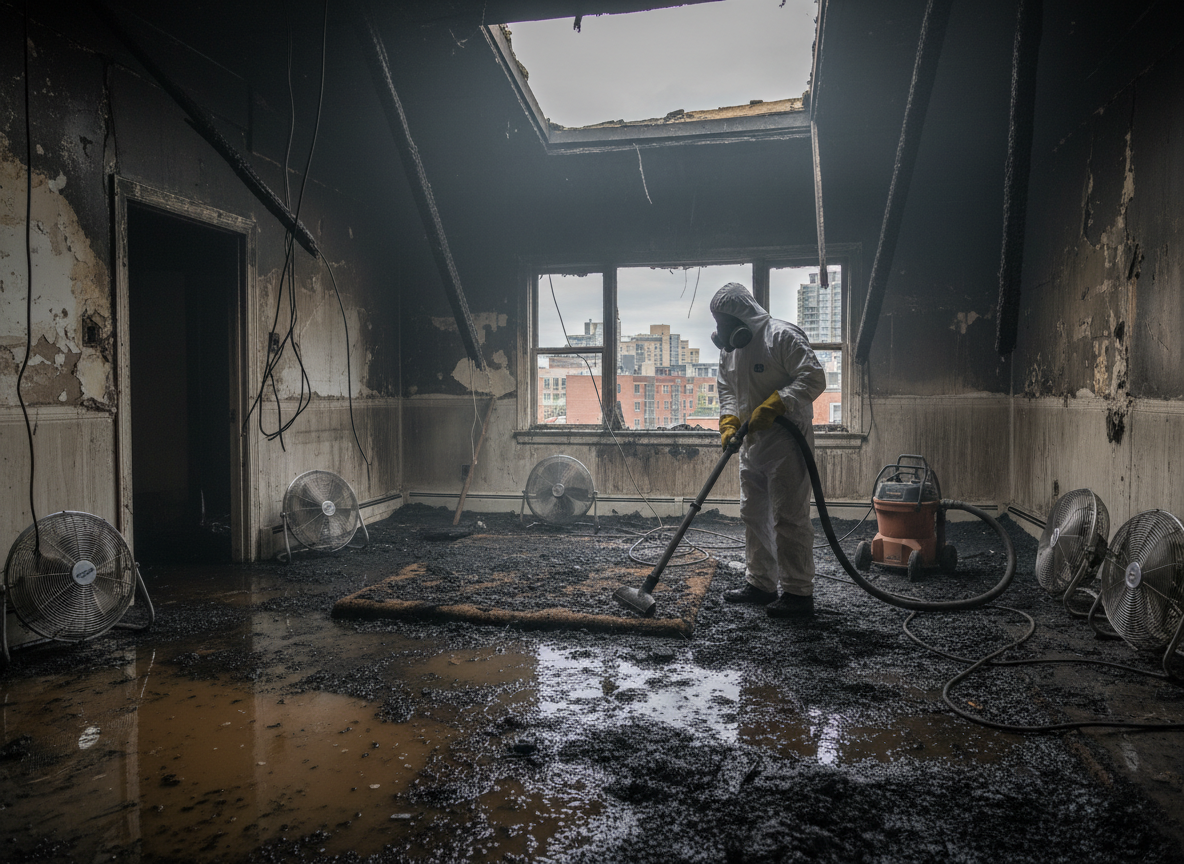
Firefighting water in Yonkers often soaks into lath-and-plaster walls common in pre-1960 homes throughout neighborhoods like Getty Square and Lincoln Park. Soot from burning synthetics bonds to porous surfaces and travels through shared chimneys and outdated HVAC runs, requiring removal before moisture drives secondary mold growth. Crews must map moisture behind baseboards and in crawl spaces beneath older foundations where Yonkers clay soils hold water longer than sandy areas farther north in Westchester County.
Summer thunderstorms or winter pipe bursts after a fire can push water into finished basements common along the Saw Mill River corridor. Extraction must account for multi-story water migration through balloon framing found in many Mount Vernon border properties. Technicians document hidden saturation in subflooring and joists before setting up drying equipment sized for the tight floor plans typical of Yonkers two-family homes.
Once visible water is removed, remaining smoke residue on brick and concrete in lower levels demands specialized cleaners to prevent odor re-entrainment when heat systems restart in fall. Failure to address trapped moisture near the Metro-North tracks or in hillside homes can lead to recurring issues when freeze-thaw cycles stress older masonry. Final verification includes checking adjacent units in attached housing where water can cross property lines.
Technician insight
In Yonkers, the thing that catches most people out with water damage remediation after fire is hidden moisture trapped behind horsehair plaster in pre-war homes along the ridges near Tuckahoe Road, where winter cold slows drying and lets soot-driven mold take hold before homeowners notice.
Firefighting Water in Two-Family Home
Water from suppression efforts entered the first-floor ceiling of a Lincoln Park two-family and migrated into the second-floor unit through shared walls. Inspection revealed saturation in the plaster and subfloor plus soot residue in the HVAC chase. Extraction and targeted drying prevented cross-unit mold while allowing both households to remain in place during the work.
How it works
- 1
Initial Assessment
Technicians inspect all affected levels, document water migration paths through Yonkers-era construction, and identify soot-laden materials requiring removal.
- 2
Water Extraction
Portable pumps and wands remove standing water from basements and floors while protecting remaining structures from further saturation.
- 3
Drying And Monitoring
Industrial air movers and dehumidifiers target hidden pockets in plaster and subfloors, with daily moisture readings until levels match unaffected areas.
- 4
Soot And Residue Cleanup
HEPA vacuuming and surface cleaning address smoke particles on salvageable materials before any reconstruction begins.
Pricing
Scope and pricing determined after on-site inspection; upfront quotes provided before work begins.