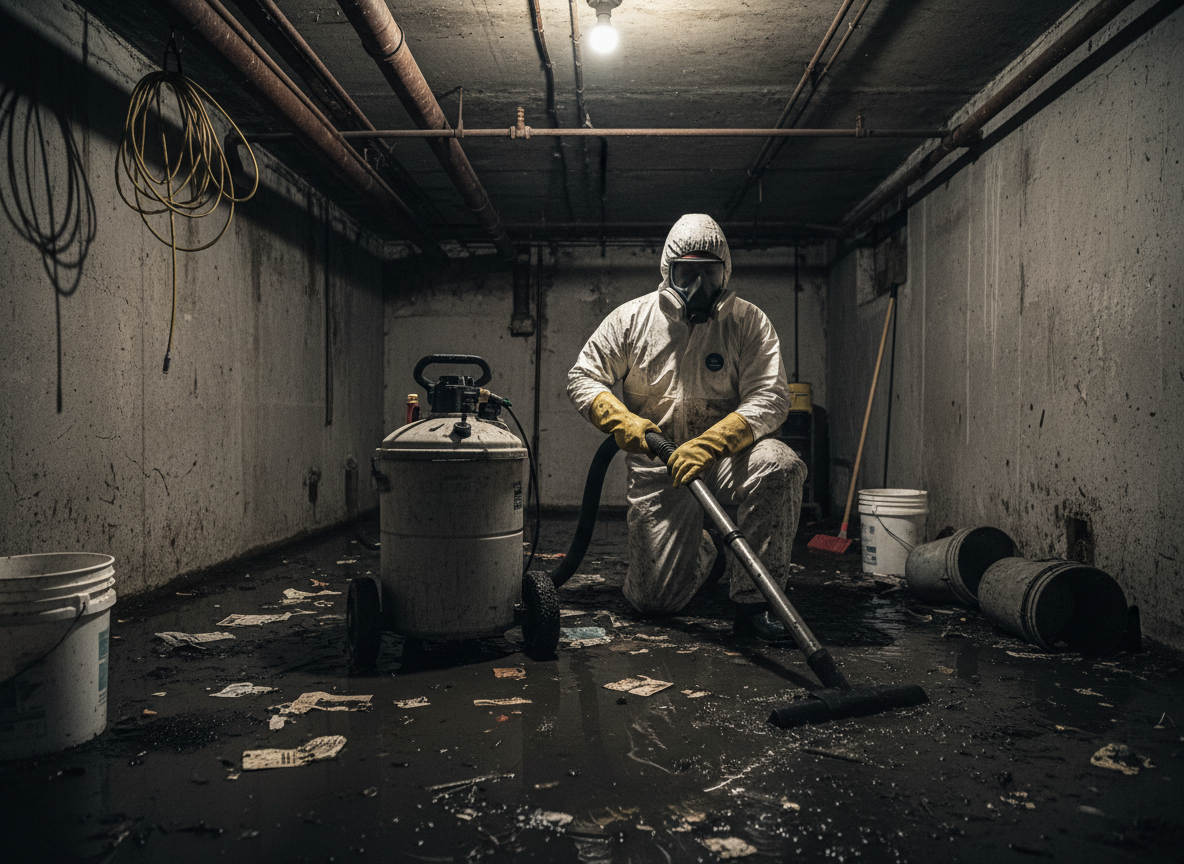
Sewage backups in Yonkers often trace to the mix of pre-war single-family homes and multi-unit buildings along Tuckahoe Road and Getty Square. Clay and cast-iron lines installed decades ago crack under root pressure from the hilly terrain and shift with freeze-thaw cycles common in Westchester County. When raw sewage enters a basement, the first priority is stopping the flow at the cleanout or main, then isolating affected rooms with containment barriers to keep pathogens from migrating through HVAC returns or shared walls in attached properties.
Removal begins with extraction of standing liquid followed by removal of saturated drywall, carpet pad and insulation up to the flood line. In Yonkers structures with slab-on-grade foundations near the Bronx border, crews must also check under-floor voids where effluent can pool unseen. All porous materials are bagged on site and disposed according to local health department guidelines. Non-porous surfaces receive repeated applications of hospital-grade disinfectants, with moisture readings taken at multiple depths to confirm the structure has returned to ambient levels before any rebuild work starts.
Homeowners frequently discover the issue only after noticing slow drains or a faint odor near floor drains during heavy spring downpours. Because many Yonkers properties sit on sloped lots, sewage can travel laterally into neighboring basements through shared laterals. Technicians therefore map the entire drainage path before starting, using cameras where accessible, and coordinate with the city sewer department when the blockage lies in the public main. Final clearance includes air scrubbing and placement of dehumidifiers sized for the square footage and construction type.
Technician insight
In Yonkers the thing that catches most people out with sewage cleanup is how quickly effluent travels laterally through the old shared laterals on sloped lots around Tuckahoe Road; a backup in one basement can reach the neighbor’s slab before anyone notices the smell.
McLean Avenue Backup
A homeowner on McLean Avenue called after noticing sewage rising through a basement floor drain following an overnight rain. Camera inspection showed roots had blocked the 1950s clay line where it crossed the property line. The crew contained the area, extracted the liquid, removed two feet of drywall on three walls, disinfected the slab and ran drying equipment for four days until readings stabilized.
How it works
- 1
Initial Assessment
Technician arrives within hours, locates the source, tests for electrical hazards and documents moisture migration through walls and floors.
- 2
Containment and Extraction
Plastic barriers seal off affected zones while pumps and wands remove standing sewage and solids from the lowest points.
- 3
Material Removal and Disinfection
Saturated drywall, flooring and insulation are cut out and bagged; all remaining surfaces receive EPA-registered disinfectants and antimicrobial treatment.
- 4
Drying and Monitoring
Industrial air movers and dehumidifiers run until moisture meters read within normal range for Yonkers construction materials, with daily readings logged.
- 5
Final Clearance
Post-remediation inspection confirms no remaining odors or elevated humidity before the space is released for reconstruction.
Pricing
Cost depends on volume, affected square footage and whether structural materials must be removed; an on-site assessment provides the accurate range.