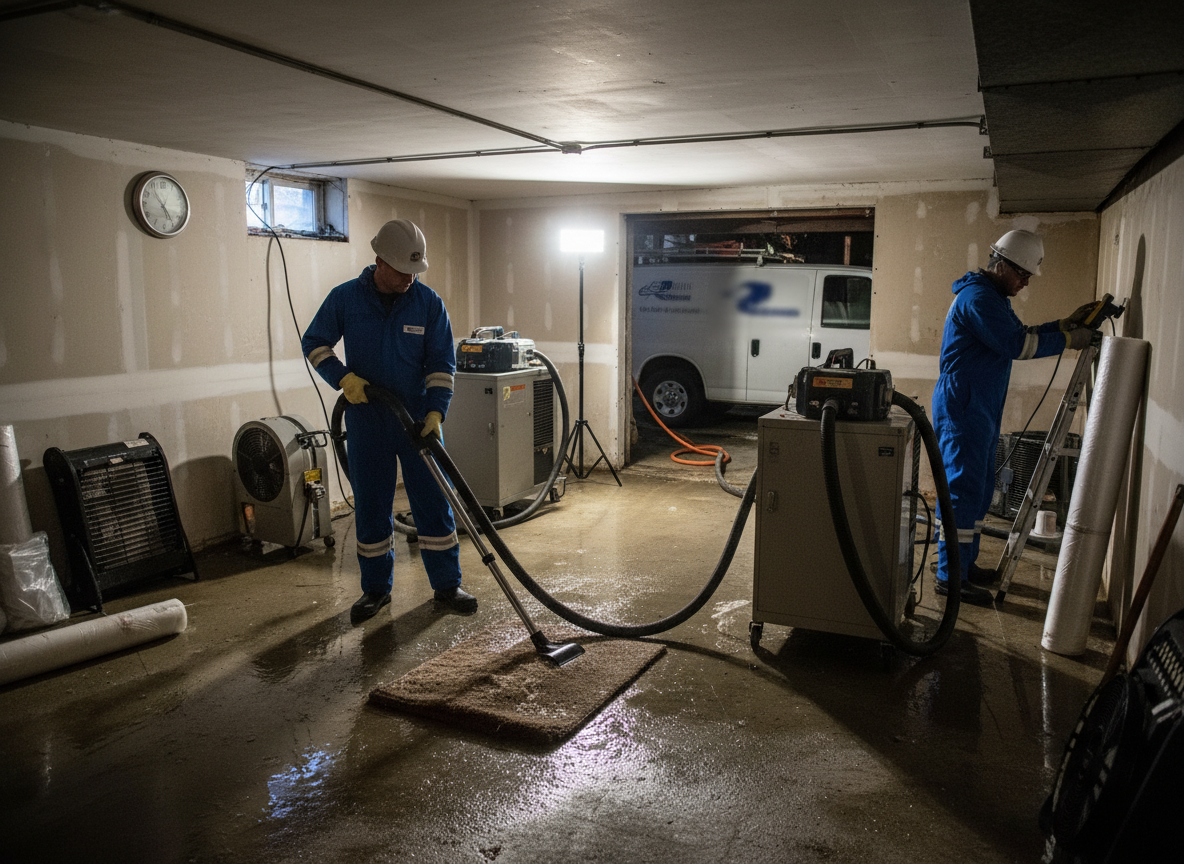
Yonkers homes built before 1960 often have galvanized supply lines and cast-iron waste stacks that corrode from the inside out. When a fitting lets go at 2 a.m., water follows joist bays straight into finished basements in neighborhoods like Crestwood and Colonial Heights. Our crews arrive with moisture meters and infrared cameras so we can trace the path before we open walls, preventing unnecessary demolition in plaster-and-lath construction common here.
Winter temperature swings in the Yonkers area freeze supply lines in unheated crawl spaces along the Saw Mill River corridor. Once thawed, the resulting flood mixes with silt from the river valley and leaves a persistent odor if the water sits longer than 48 hours. We pull carpet and pad immediately, then set up air movers and dehumidifiers sized for the square footage and the high humidity that lingers after Hudson River storms.
Many two-family houses in South Yonkers share a single main shutoff in the basement. When a tenant calls at midnight, the first step is locating that valve without flooding the downstairs unit. We carry spare curb-key extensions and know which blocks still have the original ¾-inch service lines that restrict flow during extraction.
After extraction we document moisture readings on every affected level and leave the equipment in place until readings drop below 12 percent. That step protects owners from hidden mold growth behind baseboards when spring humidity returns.
Technician insight
In Yonkers, the thing that catches most people out with 24-hour water restoration near me is the shared shutoff valve in pre-war two-family houses along South Broadway. Homeowners think they can isolate the leak upstairs, but water keeps feeding from the street main until we locate the original curb box under the sidewalk.
Burst Pipe in a Crestwood Colonial
A first-floor supply line split overnight in a 1950s house. Water traveled under the oak floor into the finished basement. We isolated the main, extracted standing water, and ran drying equipment for four days until readings stabilized. The owners avoided mold and kept the original plaster walls intact.
How it works
- 1
Immediate Dispatch
Call or text reaches the on-duty technician at 465 Tuckahoe Road; truck rolls within the hour.
- 2
On-Site Assessment
We locate the source, map water migration with meters, and photograph every affected room.
- 3
Water Removal
Submersible pumps and extraction wands pull standing water from floors and carpet.
- 4
Drying and Monitoring
Industrial air movers and dehumidifiers run until moisture readings meet industry standards.
- 5
Final Walk-Through
We remove equipment, dispose of unsalvageable materials, and provide a written moisture log.
Pricing
Upfront written scope after inspection; final cost depends on water volume, number of affected levels, and how long drying takes.